
Dry (Waterless) Pedicure in Troy, MI
A dry pedicure skips the soaking tub entirely. Hard skin is softened with a keratolytic gel and removed on dry skin with precision e-file bits, so nothing is hidden by swollen, waterlogged tissue and there is no shared basin to worry about.
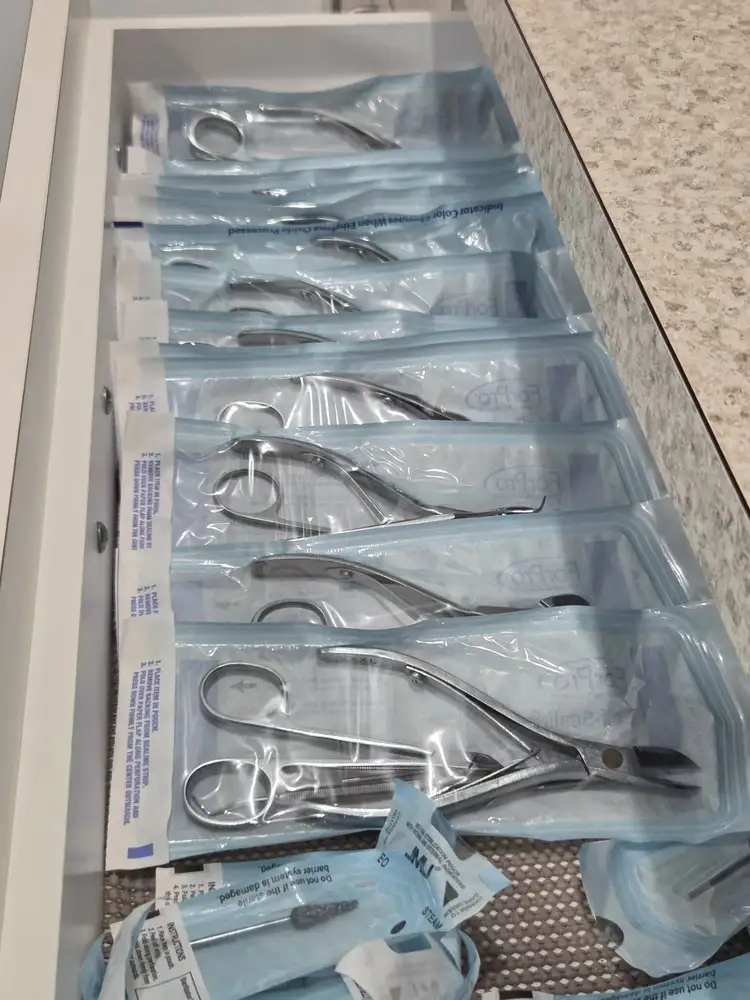
A dry pedicure is a pedicure done without soaking the feet. At MediPedi every service is waterless: skin is softened with a gel, hard tissue is removed with an e-file, and all instruments are autoclaved. It is cleaner than a foot-bath pedicure, more precise on calluses and cracked heels, and a gentler choice for people with diabetes (with physician clearance).
How a dry pedicure works
Antiseptic cleanse
Feet are cleansed with an antiseptic instead of being soaked — clean, but still dry.
Targeted softening
A keratolytic gel is applied only to calluses, corns and heels, where it softens the dead layer.
E-file work
Nails and hard skin are worked with sterile bits. On dry skin it is obvious where dead tissue ends and healthy skin begins.
Finish
Nails are shaped, skin is moisturized and you leave with a plan for home.
Dry vs wet pedicure
| Traditional wet pedicure | Dry pedicure | |
|---|---|---|
| Foot soak | 10–15 minutes in a shared basin or whirlpool | None |
| How hard skin looks | Swollen and white — hard to judge depth | Dry and clearly defined |
| Hard skin removal | Often blades or graters | E-file, layer by layer |
| Hygiene risk | Basins and pipes can harbor bacteria if not cleaned perfectly | No basin to contaminate |
| How long results last | Skin can rebuild quickly after over-removal | Typically four to eight weeks |
Why we never soak feet
Hygiene. Pedicure basins — especially whirlpool tubs with hidden pipes — are hard to disinfect perfectly between clients. Outbreaks of skin infections have been traced back to salon footbaths, the best known in California in 2000. A dry pedicure removes that risk completely.
Precision. Water makes the outer layer of skin swell and turn white, which hides the boundary between dead and living tissue. Remove too much and the skin rebuilds faster and thicker; cut too deep and you bleed. On dry skin the specialist can see exactly what to take off.
Safety for sensitive feet. Soaking softens healthy skin too, making it easier to injure. That is why waterless technique is the usual choice for clients with diabetes, thin skin or slower healing.
Dry pedicure services at MediPedi
Every service in the studio is waterless. The full dry pedicure is Healthy Nails Care ($150–200, 60 min). If you only need one thing done, choose Callus & Corn Removal (from $80), Cracked Heel Care ($70–150) or Fungal & Thickened Nail Care ($130–350). Not sure? Start with a $50 consultation.
Common questions
Will my feet really be clean without water?
Yes. Feet are cleansed with an antiseptic before any work starts, which disinfects the skin more reliably than plain water does.
Is a dry pedicure as relaxing as a spa pedicure?
It is calm and painless, but it is focused on results rather than a soak and massage. Most clients find the comfort of walking afterwards is the best part.
Is a dry pedicure good for people with diabetes?
It is the gentler option, because there is no soaking and no blades. We ask for your physician’s clearance before the first visit.
How long does a dry pedicure last?
Results typically hold for four to eight weeks, depending on your shoes and how much you are on your feet.
How much does a dry pedicure cost in Troy?
At MediPedi the full dry medical pedicure is $150–200. Single-area services start at $70 for cracked heels and $80 for calluses. New clients get 10% off the first visit.
Related care & guides
Book your visit
New clients get 10% off. No payment online — you pay in studio after your care.
2891 E Maple Rd, Troy, MI 48083 · Tue/Thu/Sat 9am–8pm · Mon/Wed/Fri 4pm–8pm